






Blog
Use of Perforated Sheets in Acoustic Applications


Use of Perforated Sheets in Acoustic Applications
Noise control and the improvement of sound quality are an important part of modern building and industrial design.
Perforated sheets play an effective role in acoustic arrangements by offering both functional and aesthetic solutions.
A properly designed perforated sheet panel controls sound propagation, reduces echo, and creates a more comfortable environment.
What Is a Perforated Sheet and How Does It Work Acoustically?
Perforated sheets are metal plates with holes arranged in specific patterns on their surface.
In acoustic applications, sound-absorbing materials such as rock wool or glass wool are placed behind these panels.
Sound waves pass through the holes and reach this material, where they are dampened.
This system is particularly effective in reducing reverberation time.
Key Parameters Determining Acoustic Performance
Acoustic performance is determined by the correct combination of the following technical parameters:
- Hole diameter
- Hole shape (round, oval, etc.)
- Open area ratio
- Sheet thickness
- Backing fill material
- Air gap (distance behind the panel)
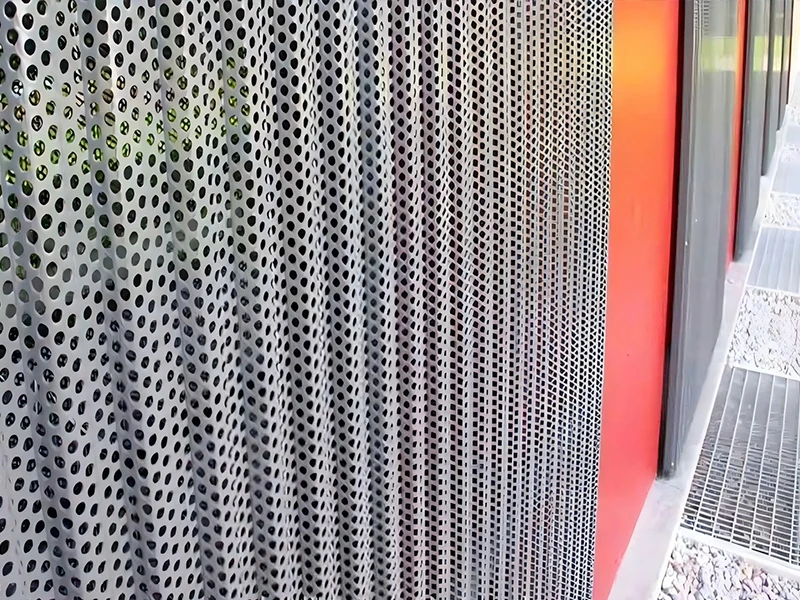
Acoustic Performance by Hole Diameter
Small Hole Diameters (0.8 mm – 2 mm)
Areas of Use: Offices, meeting rooms, acoustic panels
- Effectively absorbs high-frequency sounds
- Provides a more homogeneous surface appearance
- Preferred in micro-perforated applications
Medium Hole Diameters (2 mm – 6 mm)
Areas of Use: Concert halls, cinemas, shopping malls
- Provides balanced performance at mid frequencies
- The most commonly used size range
- Holes between 3 mm and 5 mm are frequently preferred
Large Hole Diameters (6 mm and above)
Areas of Use: Industrial areas, machine rooms
- Provides high sound transmission
- Can be more effective at low frequencies
- Suitable for high-noise environments
Open Area Ratio (Perforation Ratio)
The open area ratio refers to the proportion of holes relative to the total surface area and is one of the most important determinants of acoustic performance.
10% – 20%
- Provides controlled sound transmission
- High-frequency-focused applications
- Office and interior solutions
20% – 35%
- Balanced acoustic performance
- The most ideal and common range
- Concert halls and theatres
35% – 50%
- High sound transmission
- Industrial noise control
- Low-frequency-supported systems
Design Tips to Improve Acoustic Performance
- At least 30–50 mm of sound-absorbing material should be used behind the panel
- Leaving an air gap improves low-frequency performance
- A wide frequency range is achieved with different hole combinations
- Oval holes offer a directional flow advantage in some applications
Areas of Use
- Concert halls and theatres
- Offices and open-plan workspaces
- Shopping malls
- Airports and stations
- Factories and production facilities
Conclusion
Perforated sheets offer highly effective acoustic solutions when the correct hole diameter and open area ratio are selected.
Small holes control high frequencies, while large holes and a high perforation ratio support low-frequency performance.
For a successful acoustic design, all of these parameters must be evaluated together and optimised for the specific project.


